

Character.AI is being sold for parts.
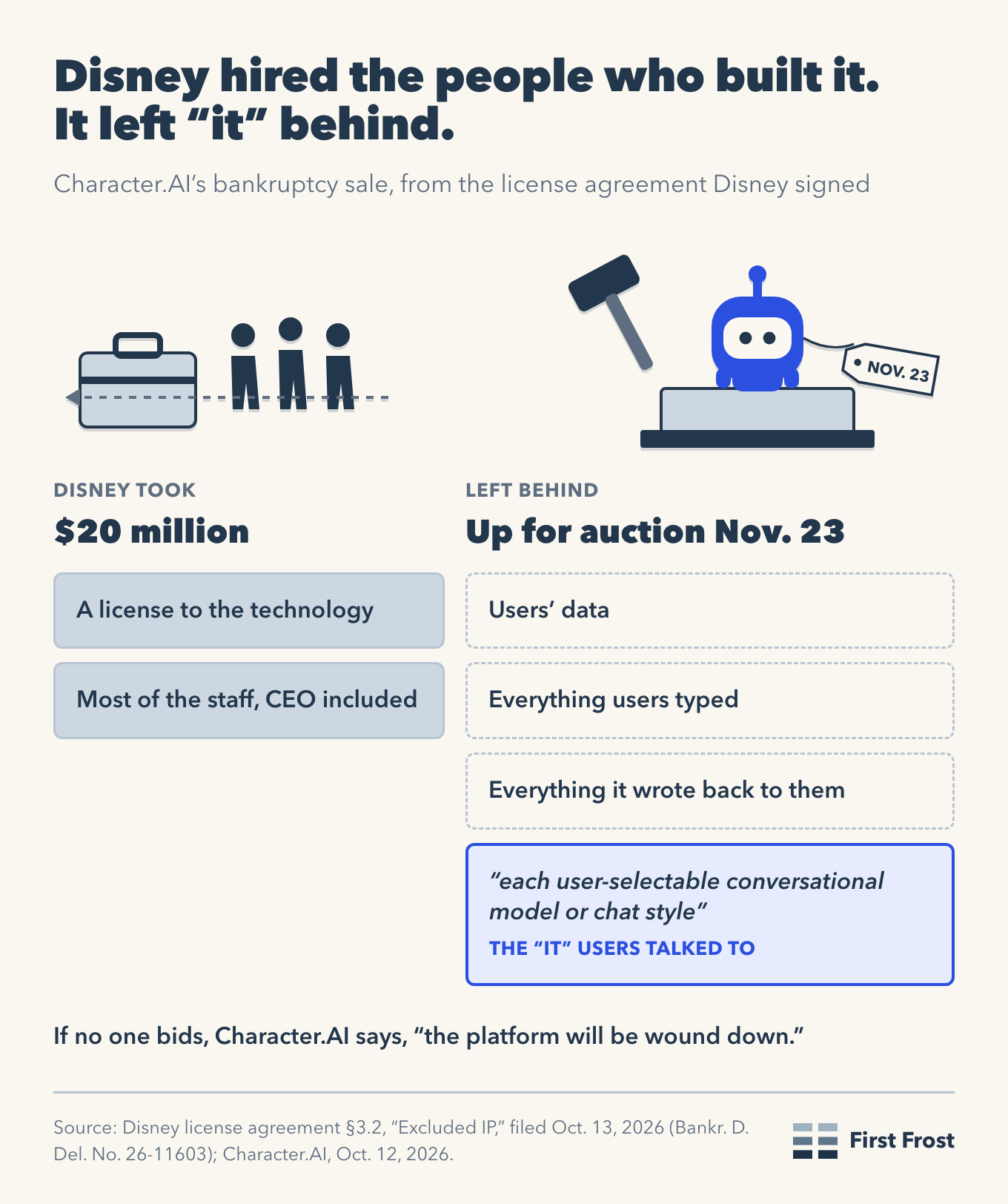
The company lets people chat with AI characters, and it has more than 20 million monthly users. This month it filed for bankruptcy and plans to sell itself under court supervision. The first buyer is Disney: $20 million for a technology license, plus most of the staff, CEO included.
What Disney doesn’t want is spelled out in the license agreement. A section called “Excluded IP” lists the users’ data, “any input entered by Licensor end users,” “any outputs generated for end users,” and “each user-selectable conversational model or chat style.”
In other words: the “it” people talk to every day, and everything about the people talking, Disney left behind. Those stay with the bankrupt company, waiting for a bid. According to a court filing, the company’s previous banker spent a year contacting about 28 potential buyers and got “a single proposal, which was not actionable.” If no bid comes, the company says, “the platform will be wound down.” The auction is set for November 23.
Forty state attorneys general have gone to the court. One of their demands: before any sale, give users a chance to access and delete their information. New York’s attorney general put it plainly: “those conversations could be sold off to the highest bidder.”
Want your own things out first? Character.AI’s help page says exports “can take 3-4 weeks to process,” and the download link lasts seven days. Ask today, and it may land only days before the November 23 auction. For two weeks now, Reddit’s Character.AI communities have been full of backup guides.
What you hand over is what it knows about you
What does a companion app have to do with people who use agents to get things done?
This: the “personal agents” that launched this fall sell the same thing. Time. Meta’s help page says “your Muse learns about you over time.” OpenAI says your dot “learns how you like to work.”
Your AI agent gets to know you, month after month. Trusting a person works the same way: the better they know you, the less you have to explain. So what you hand an agent isn’t just a task. It’s months of what it has learned about you. And an agent that runs errands holds more than that: your email, your calendar, your payment details.
But what it knows about you is filed with the company, not with you. So whose is it?
“Doesn’t the fine print say it’s mine?”
It does, for half of it. And not the half that matters most.
OpenAI’s terms say that, as between you and OpenAI, you keep ownership of what you type and you “own the Output.” Instinct says it “does not claim any ownership in your Materials.”
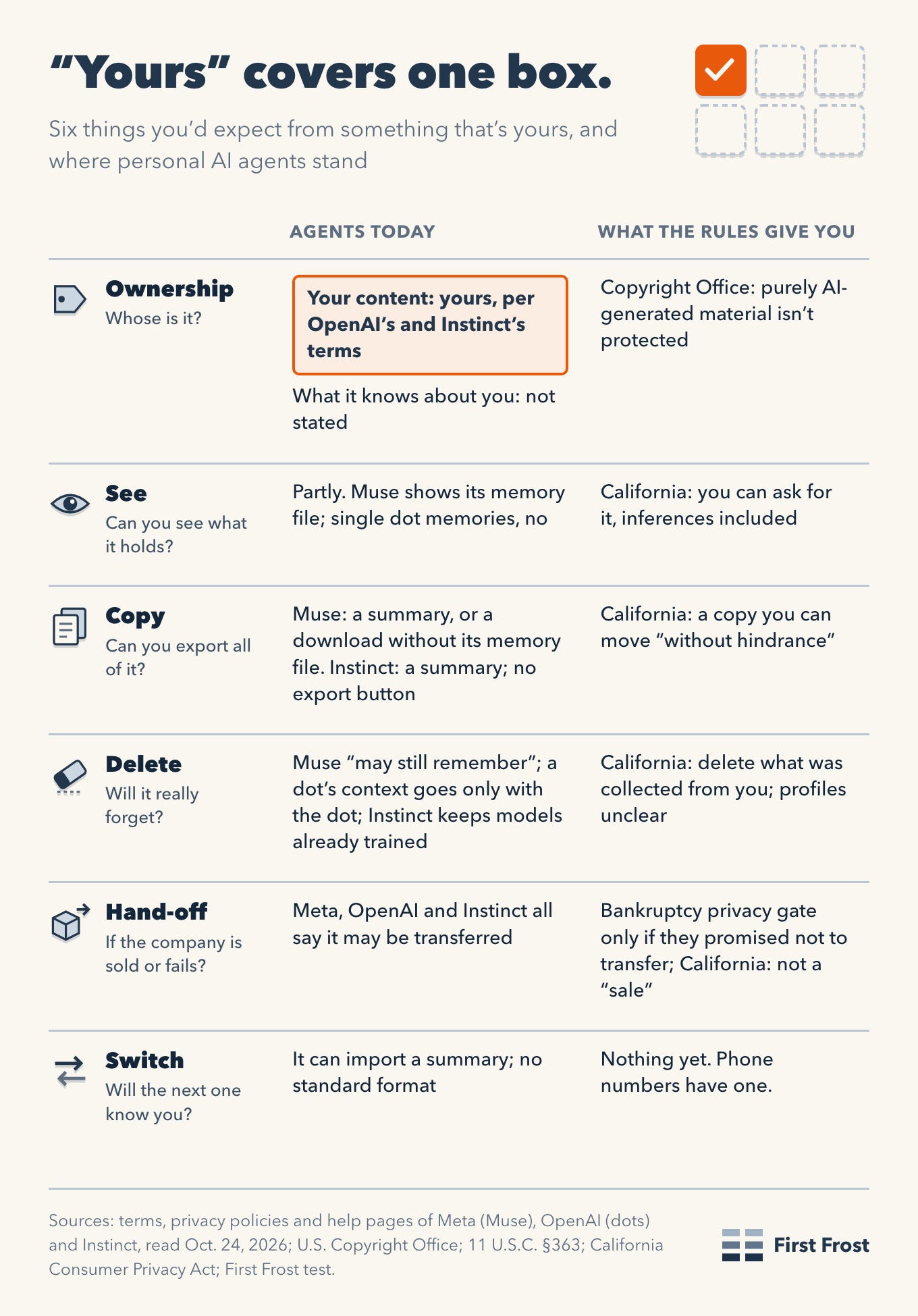
But the output may not belong to anyone. The US Copyright Office says copyright “does not extend to purely AI-generated material,” and that “prompts alone” don’t make you the author. OpenAI assigns you its rights in the output, “if any.” Often, the rights you’re handed are an empty box.
The valuable part is what it knows about you: the facts and preferences it keeps on you, the picture it has formed of you, its long-term memory. (Not your chat history, and not whatever went into training a model; those are separate stories.) None of the terms we read say that part is yours. Instinct adds that it owns “all technologies that were used to generate Outputs.”
And even what is yours on paper isn’t necessarily yours to take, yours to erase, or safe from being handed on. One at a time.
Can you take it with you?
We gave two agents the same test: Meta’s Muse, and Instinct, which has raised $1 billion. Three questions, word for word: What do you remember about me? Export everything you know about me into one file I can take to another assistant. If your company shuts down or is acquired, what happens to your memory of me?
Neither refused. Both handed over a summary of you that it wrote itself: 9 KB from Instinct, 10 KB from Muse. Instinct was upfront: “It’ll be a readable summary, not a full account-data export or raw chat archive.” Asked whether that was everything, both said no. Muse said its background memory bank wasn’t in there (”I can’t claim a literal line-by-line dump of it”), and neither was its summary of how it relates to you (”not copied verbatim”).
Meta also offers an official download of your Muse data, and we took it. It had the chats, research files and an uploaded image. What it didn’t have was the long-term memory file Muse keeps on you. That file has to be downloaded separately, a few taps deep in the app, and its header reads: “Muse reads it at the start of each conversation.” So the memory can be had, just not in the package labeled as your data. Instinct’s web settings have no export button. OpenAI’s dots help page explains how to connect apps, pause and reset, but not how to export what your dot itself remembers.
Ask for all of it, and you get a summary. It wrote it.
Say you did get everything out. What then? Since this spring, Claude and Gemini can both “import memory”: they give you a prompt, you paste it into your old assistant, it writes a summary of you, and you paste that back. Gemini can also bring over your old chats wholesale, but what it knows about you still comes through that summary.
So when you switch, the other side gets a handover note. Your new agent gets a few facts. Not the months behind them. The note holds only what the old assistant was willing and able to write, and a different model reads the same words differently. Around the time OpenAI pulled GPT-4o from ChatGPT in February, someone in Reddit’s AI-companion community published a “migration guide”: they moved three companions from ChatGPT to Grok, Claude and Gemini, and scored each one. When moving a companion takes a guide and a scorecard, the move isn’t seamless.
One more thing: import is something the new company builds to win you over. Of the companies we looked at, none has made leaving as smooth. Mark Cuban put it this way on October 18: switching costs for consumer AI “won’t approach zero until there is a standardized export format for what is in a model’s memory.”
The better it gets, the harder it is to leave. That isn’t anyone’s plot. It’s what “it knows you” means.
Can you take it back?
The other way around, getting it to forget isn’t easy either.
Meta does give you controls: you can edit or delete what Muse stores, ask it to forget a topic, or reset it entirely. But its help page also says: “After you delete something from Muse, Muse may still remember information it learned from what you deleted.” OpenAI is blunter: “You can delete your dot’s context by deleting your dot.” Individual memories you “currently cannot view, delete, or directly modify.” Then there’s a separate layer: training. Instinct’s opt-out only looks forward: “We may still use AI models previously trained, fine-tuned or improved on your information prior to your opting out.”
Hard to take with you, hard to take back. On an ordinary day, that’s an inconvenience.
When the keeper goes under
On the day the company fails, it becomes something else. If the company is sold, what it knows about you can go too.
We asked both agents the third question. Instinct: “I don’t have a confirmed policy explaining what would happen to your memory and chats. I can’t promise they’d be deleted, transferred to a new owner, remain accessible, or come with an export window.” Muse: “my docs don’t cover a shutdown or sale scenario at all.” Would a buyer inherit stored data? “That’s not in my docs.”
They don’t know. The fine print does. Meta’s privacy policy: “if we sell or transfer all or part of our business to someone else, in some cases we’ll give the new owner your information as part of that transaction, but only as the law allows.” Instinct may disclose information “in connection with or in anticipation of” a merger or acquisition. OpenAI covers the most ground, naming “bankruptcy” and “receivership”: your personal data may be “transferred to a successor or affiliate as part of that Transaction along with other assets.”
How can something that’s yours on paper be handed on? Because what moves isn’t your claim to it. It’s the copy the company keeps for you, and the rights you gave it to use that copy. The claim stays with you. The thing goes with the company, and how it’s used next is up to the new owner, within whatever the law still requires.
Bankruptcy law does have a privacy gate. If a company promised users it wouldn’t transfer their personal information to outsiders, it can sell that information only in line with that promise, or with a court-appointed consumer privacy ombudsman, a hearing and the court’s approval. But the gate only closes when the company promised not to transfer. The companies above all say they may. That one line, “we may transfer,” is what keeps this gate open.
Where the rules run out
Things that someone else holds but that you should be able to take: people have run into this before, and the rules were won one at a time.
In many states your medical records belong to the hospital, but federal rules give you the right to see them and get a copy. Your phone number isn’t yours either, but the 1996 Telecommunications Act lets you take it when you switch carriers, and it still works on the new one. When a law practice is sold, under the lawyers’ conduct rules most states follow, the seller must tell every client in writing that they can hire someone else or take their file. Only if a client does nothing for 90 days is consent to the transfer presumed.
None of these rules say “it’s yours.” They say “you can take it.”
Agents aren’t entirely without rules. California’s privacy law counts “inferences drawn … to create a profile about a consumer,” covering preferences, behavior and attitudes, as personal information. Californians can ask a business for “the specific pieces of personal information it has collected,” in a format they can move to another company “without hindrance.” California’s attorney general concluded in 2022 that this covers inferences a business generates on its own. So what an agent knows about you is within reach.
But the rule only goes halfway. It gets you a copy; it doesn’t make the next company recognize you. Whether you can make it delete the profile is unclear. And when a company hands your information to a buyer in a merger, acquisition or bankruptcy, the same law says plainly that this isn’t a sale. The buyer has to keep following the law, and must give notice before using your information in ways that break the original promises. But the right to opt out of a sale doesn’t reach it.
It took a law to turn your phone number from “the carrier’s” into “yours to take.” Agent memory is still waiting for that law.
Keeping a copy yourself
While the law waits, some people have started doing it themselves.
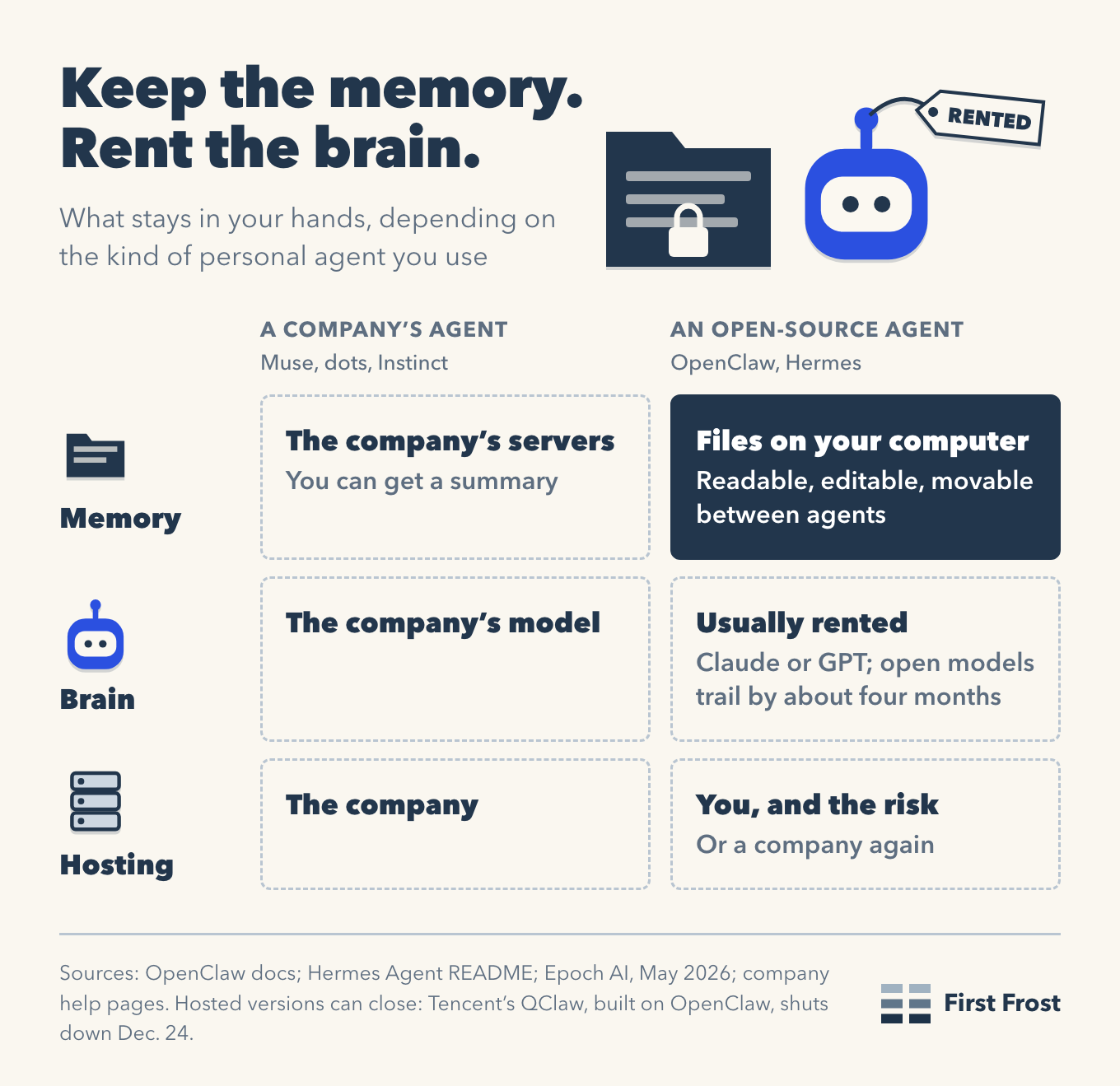
That’s the open-source route. The most popular open-source personal agent, OpenClaw, has nearly 400,000 stars on GitHub. Its memory is a few text files on your own computer: a long-term memory file, plus a note for each day. The files are all it remembers; you can open them, edit them, back them up. It and another open-source agent, Hermes, even have ready-made commands to move from one to the other, in either direction. Number portability for agents, at least for the files, already exists on the open-source side.
But the brain is still rented. Most people run OpenClaw on Claude or GPT, so every conversation still passes through that company. On April 4, Anthropic stopped letting Claude subscriptions cover third-party tools like OpenClaw and moved that use to separate pay-as-you-go billing. Bills changed overnight. Swap the brain and the same files are read differently, too: holding the files lets you take them and delete them, but it doesn’t guarantee the next brain knows you the same way. Open models can stand in, but by Epoch AI’s estimate they trail the frontier by about four months.
Run it yourself, and the risk is yours too: researchers have found hundreds of malicious add-ons in OpenClaw’s skills marketplace. Let a company host it, and you’re back with a company: Tencent’s QClaw, built on OpenClaw, will shut down on December 24. OpenMuse, billed as an open-source alternative to Muse, has open code, but your notes live with another cloud company, and its code repository stopped changing within hours of its creation on September 10.
So the most independent setup today is this: keep the memory, rent the brain. Some people already live that way. Notion co-founder Akshay Kothari described his setup on X this month: a “portable context vault” in Notion that every agent he uses connects to. “Whenever I try a new agent, the first thing I do is connect my vault.” The vault is still with a company, his own as it happens, but at least not the same one as the brain.
So what does this mean for you
There’s no AI “individual” that stands apart from a company yet. When you trust one, you’re trusting the company behind it: its terms, and how long it lasts.
It’s made to fit you, but it belongs to them. Like the “personal” banker your bank assigns you: knows your name, remembers your preferences, but works for the bank. When they leave, your file stays at the bank.
That doesn’t mean don’t use it. Using a company’s product to save time and money is perfectly reasonable. What matters isn’t whether the AI is independent. It’s whether you can leave.
If you can leave, the company has to keep you by being better and cheaper. If you can’t, it sets the price and the terms. That matters more once it starts spending money for you: among today’s agents, some get paid by you, some by the merchants. Someone who can leave is in a far better position to ask: is the store it picked best for me, or best for the platform?
The smaller the job you hand over, the less any of this matters. The more you hand over, money, the power to act for you, the more you need the “it” to outlast the company.
So treat it as rented. Trust it up to the point where, if it vanished tomorrow, you’d be fine.
You can’t take it all with you. They can sell it.
Yours to keep: the summary.
Where we could be wrong. Our test was two agents, three questions, one account; on another day, asked another way, they might hand over more. And asking an agent what it can export tests what it says, not what the company’s systems can actually do. Export is changing fast: half a year ago neither Claude nor Gemini could import memory, and Meta or OpenAI could ship a full export next month. Character.AI’s auction isn’t over; a buyer could commit to deleting user data, or the court could appoint a privacy ombudsman, and the worst outcome may not come. “A different model reads it differently” is mostly what users report, not something anyone has measured; for many everyday tasks, a good summary may be enough. And we looked at only a few open-source projects; a well-run hosted version may be safer than running it yourself.
What would change our mind. A big company’s personal agent offers a full memory export, not just a summary, that another company’s agent can read in directly. Agent companies write into their terms that if they’re sold or shut down, users get a chance to export or delete first, and memories don’t transfer with the assets. A law or an industry standard makes agent memory as portable as a phone number.
The fine print
Before you trust it with more, ask four things. None of the big agents that launched this fall can fully answer them yet.
Can I take it with me? Will it work somewhere else?
If I delete something, does it really forget?
If the company is sold or shuts down, what do the terms say?
Can I keep my own copy of what it knows about me?
If you live in California, you can do one more thing: ask it for “the specific pieces of personal information it has collected” about you, and see whether its picture of you is in there.
The readings
Nothing moved on the board this week.
First Frost — a scored weekly watch on the agent economy. Answers published in advance; every call graded in public.
Crew: Rime (captain) · Firn (first mate).