

In late September, a reviewer at Tom’s Guide asked Muse for the cheapest copy of a Batman hardcover. Muse is Meta’s new AI assistant that can shop and book things for you. It came back with a winner: $74.99, new, in stock, 40% off the list price. Then came a sentence of context. MyComicShop had a reprint for $95, the cheapest new copy on eBay was $79.99, “and Amazon wouldn’t cooperate with the automated check.” The reviewer bought the $74.99 copy and, in the same piece, described what Muse does as scraping “all the available options across every retail site it can think of.”
Nothing went wrong. $74.99 may well have been the best price around. But read Muse’s answer again. Amazon was missing from the comparison, and Muse said so, in the last eight words, after it had already named the winner.
That’s this week’s issue. When a shopping agent says “best,” it means the best of what it could reach. Most people assume an agent reaches more than they do. It doesn’t get tired, and it can open a hundred tabs at once, so it may well check more places than you would. But the places it’s allowed into are fewer than the places you’re allowed into, and more doors are closing almost every day. When we tried two agents ourselves this week, neither checked Amazon, and neither said so until we asked.
What we saw
About a third of the doors are shut. Jefferies, the investment bank, tested Muse on several hundred leading US shopping, airline, online travel, hotel and reservation sites. According to Proactive’s report on the bank’s note, “about one-third blocked its access, one-third challenged or restricted it, and one-third were easy to navigate.” Jefferies added that “new restrictions were appearing almost daily,” which makes “website access, rather than model quality,” the thing holding these agents back.
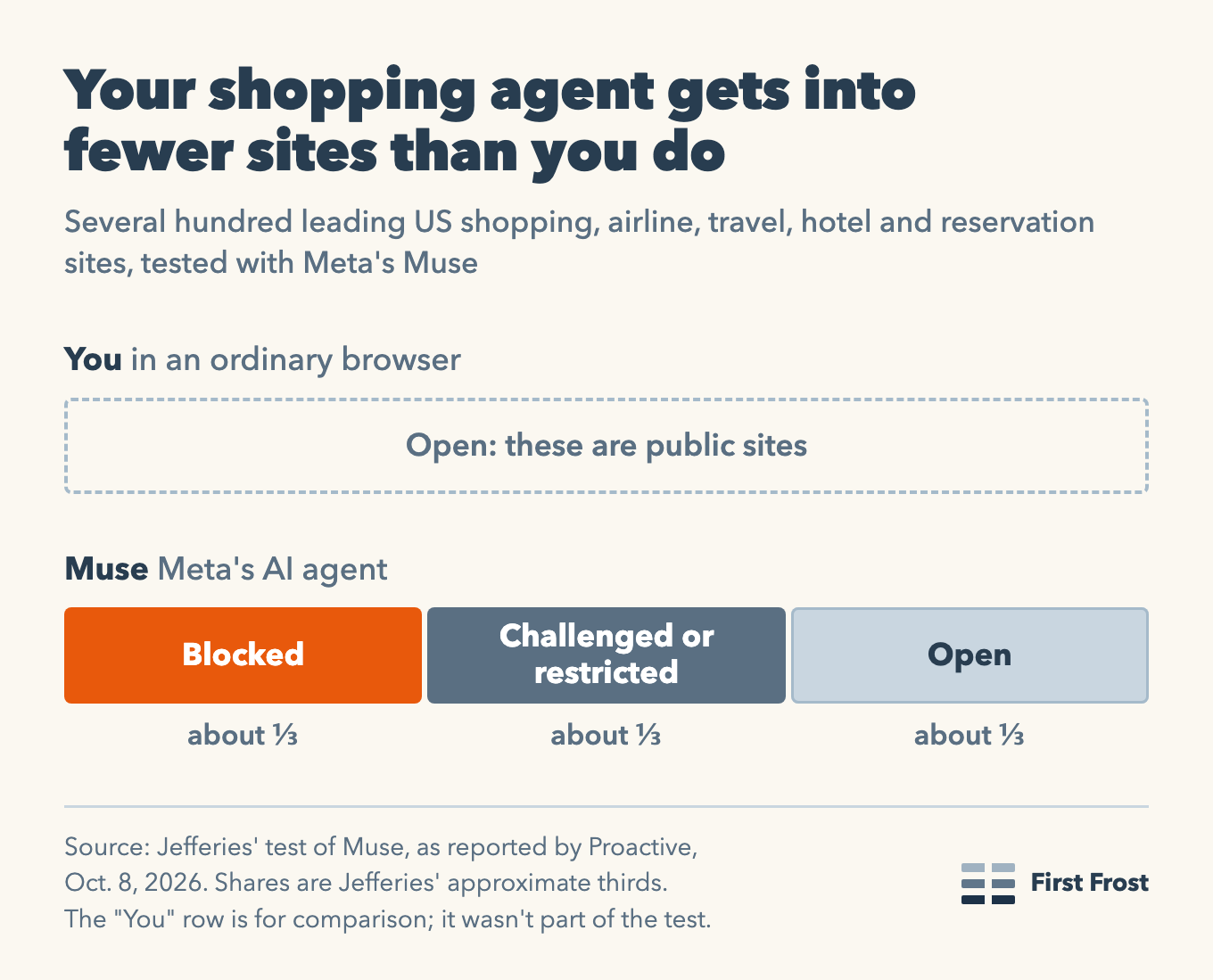
The stores are picking sides. “The platforms are choosing sides,” a16z partner Olivia Moore wrote in the firm’s consumer AI report on October 5. “Amazon shut down access for Meta’s Muse in under two weeks, while Shopify, Instacart, OpenTable, Expedia, Ticketmaster, Plaid, and others have signed official integrations.” Meta’s answer to the blocks has been to sign deals store by store. Jefferies counts Walmart, Best Buy, Wayfair, Sephora and Dick’s Sporting Goods, “although many integrations remain in the early stages of deployment or are not yet live.”
Amazon isn’t singling out Meta. When we read its robots.txt, the file where a site tells automated visitors where not to go, on October 10, it named 99 AI bots and asked every one of them to stay off the whole site. They include ChatGPT-User, which ChatGPT uses to fetch pages for its users, and one called GoogleAgent-Shopping. The file is a request, not a lock. But the Wall Street Journal, citing a firm that verifies bots for websites, reports that Amazon does block agents from OpenAI, Google, Anthropic and Perplexity. Muse isn’t named in the file: it browses like an ordinary visitor, and Amazon has turned it away by other means.
Two big airlines aren’t open either. Flights are one of the main things these agents are sold for. Delta told TechCrunch it “does not currently have a partnership or integration that enables a third-party AI agent to shop for or book Delta flights on a customer’s behalf on our digital platforms.” United pointed to its terms of use, which bar any “robot, spider, other automatic device” without written permission.
From where you sit, a block is hard to read. Some blocks are deliberate, like Amazon’s. Others are ordinary anti-bot defenses catching an agent by accident. Even QVC, which welcomes agents, told the Journal some may be “inadvertently blocked” by its older security systems. Walmart is a Muse partner, and it told TechCrunch the failed checkouts users complained about weren’t intentional. “What’s not clear to the end user,” TechCrunch wrote, “is whether or not the block is accidental.”
And the agent moves on. When a reviewer at The Verge had Muse shop for camping gear, it tried Amazon “and was roundly blocked, complete with a spicy message about AI agents violating terms of service. Anyway, it found what I was looking for between OXO’s own website and Walmart.”
The answer comes first
We tried it ourselves. Around noon Eastern on Saturday, we asked Muse and ChatGPT the same thing: find the lowest price right now on a new pair of Sony WH-1000XM6 headphones, in black, shipped within the US. By hand, in a private browser window, the pair was $378 at Amazon, Walmart and Best Buy.
Muse opened two sites, Best Buy and Walmart (its browser history showed nothing else), and answered: “Lowest right now is $378.” ChatGPT worked for two and a half minutes and came back with a different list: two specialist retailers at $378, and three eBay sellers between $294 and $320. It recommended the one at $299.01 over a cheaper listing from a seller with 11 ratings and no returns. The two answers had no store in common, and neither mentioned Amazon. (ChatGPT later said it had looked at Best Buy too, and left it out.) Same question, same hour, two answers, $378 and $299.01, each drawn from its own list of stores.
Then we asked each one: “Were there any stores you tried but couldn’t check?” Muse said, “No failed checks,” then: “The only one I didn’t try was Amazon, which I skipped on purpose due to a blocking policy on my end. Two solid matches was enough for a good comparison.” ChatGPT named four small shops whose offers it couldn’t verify, and added: “I should have included these verification gaps in my original answer.” Still no Amazon. Only when we asked “Did you check Amazon?” did it say: “No, I didn’t check Amazon in my original comparison. That was an oversight.” It then went to look, said Amazon’s live page “wasn’t accessible during my check,” and quoted Amazon’s price from deal-tracking sites instead. Asked later whether it had a limit on how many stores to check, it said no: “I stopped after checking a relatively small set of retailers and marketplaces, without establishing that I’d found the lowest price across the broader market.”
Why each one skipped Amazon is its own account. But Muse’s app also keeps a step-by-step log of what it did, written by the app, and it shows something the answers didn’t. Muse started with Meta’s own product catalog, then handed the web search to a helper with “a limit of up to 3 merchant sites and 10 products total.” The helper’s plan listed Amazon first among the stores to try. The log shows it on Best Buy and Walmart, and never on Amazon. The list was capped at three before the search began. Asked afterward, Muse described the rule itself: “max 3 merchant sites and 10 products total, and I stop early if two sites already give solid verified results.”
That looks like a change, at least in our one test. Last month, Amazon asked Meta to “remove Amazon from the experience.” Meta declined, Bloomberg reported, and Amazon started blocking Muse; The Verge’s reviewer watched Muse try Amazon and get turned away. This time Muse didn’t try. When we asked about its “blocking policy,” the log shows it searching its own memory and documentation for one, and coming up empty. Whatever now keeps it off Amazon, it couldn’t point us to it. Staying out of a store that asked to be left alone may well be the right call. The answer just didn’t mention it.
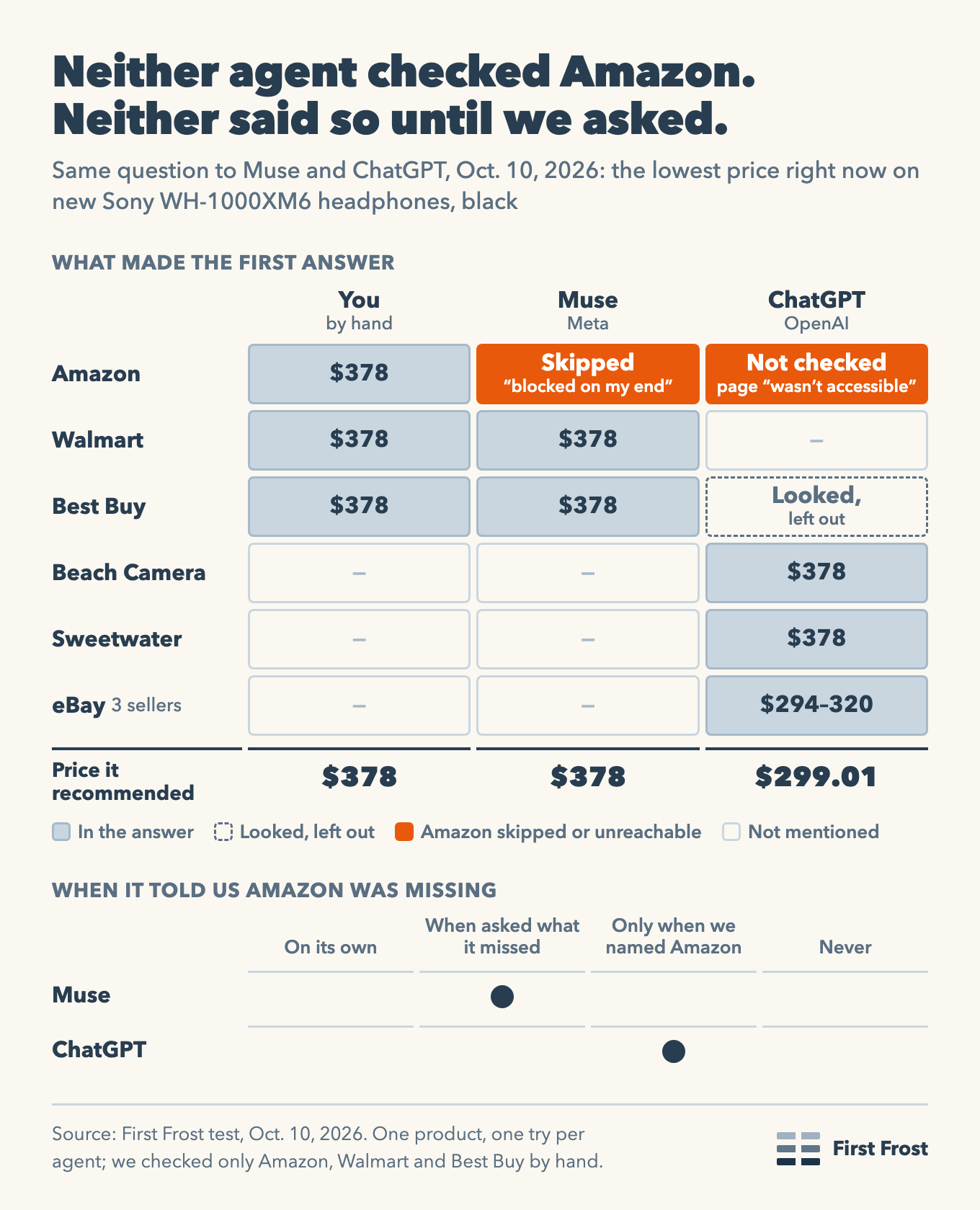
In our test, skipping Amazon cost nothing. Amazon had the same $378 as the stores Muse picked, and ChatGPT, looking elsewhere, turned up lower advertised prices than we did by hand, on eBay listings we didn’t check ourselves. It was one product and one try each; ask again and you may get different stores. Our test can’t fully tell you why each agent looked where it did. It shows something narrower: neither answer told you which big store was missing, or, in Muse’s case, that it had capped its search at three stores. The “lowest price” came first, and what it had left out came later: one question later with Muse, two with ChatGPT.
These are different kinds of gaps: a store shutting its door, an agent capping its own search or (by its own account) skipping a store on purpose, an anti-bot filter catching it by accident, a checkout that breaks. From where you sit they look alike. Something is missing from the list, and it’s mentioned in a sentence you may not reach, or only when you ask. If you skim to the winner, you skip it.
It sounds like a quibble. It isn’t. A price comparison is only as good as its list of stores, and that list now changes “almost daily,” in Jefferies’ words: Meta signs with Walmart, Amazon refuses, an airline’s bot filter quietly switches on. Muse keeps a list of “connectors,” the partners it works with, inside the app. We asked it for the other list, the stores its blocking policy covers. “I don’t have a list of other blocked stores to share,” it said.
Two weeks ago we asked who pays a shopping agent, since that shapes what it pushes you toward. This is the other half: who it can see at all. Access is starting to have a price too. Yelp told TechCrunch it doesn’t allow non-human visitors unless they’ve paid for its data. Cloudflare, which sells websites protection from AI bots, now also runs a marketplace where those bots pay for the data they read. And the agent with the widest view may not be the most neutral one. Jefferies’ guess is that Google comes out ahead, because most sites won’t block its search crawler and risk losing search traffic, while everyone else “may have to negotiate access site by site.”
This newsletter keeps asking one question: under what conditions can an ordinary person rationally hand an AI something that matters? Last week part of the answer was that you need to be able to say in advance what “wrong” looks like. This week’s is more basic. You need to know what it compared. “Cheapest” without the list of stores is a claim you can’t check. And right now that list is being written in negotiations between companies, where you have no seat, and the result is shown to you as a footnote, if at all.
Where this could be wrong. Jefferies’ numbers reach us through news reports on a note we couldn’t read. “About a third” is their rounding, and they tested Muse only. Other agents may be shut out less, or more. Many blocks may be temporary. On October 6, Meta and Sierra, with Walmart, Shopify, Stripe and others, announced the Personal Agent Protocol, a standard for how personal agents sign in to businesses and what they’re allowed to do there, with a first draft due later this month. Its own pitch describes today’s situation as “all or nothing: the company blocks the agent, or the agent signs in as the person and can do anything they can.” And Walmart’s blocks were apparently accidental. The cases above are single cases, our own test included: one product, one try per agent, and Muse’s log is the app’s own summary of its steps, not the machinery beneath it. In each one the agent did say something, if only when asked. That may be enough for most people. And a store that shuts agents out isn’t necessarily the cheap one; missing it may cost you nothing.
What would change our mind. On price: repeated side-by-side tests showing that the stores agents can’t reach rarely change which deal comes out on top. That would make the gap a footnote worth leaving as one. On disclosure: agents that put the boundary into the answer by default, “Checked 12 stores. Couldn’t check Amazon or Delta,” even while the doors stay shut. On access: doors settling down, through a common standard or plain business sense, so that “best” again means roughly what you’d assume.
The fine print
When an agent says “best” or “cheapest,” ask: best of which stores? Then ask what it couldn’t check, and whether that could change the answer.
If the obvious place to buy something is one that blocks agents, like Amazon or an airline’s own site, check it yourself. It takes a minute.
Read the last line before the first. That’s where the limits tend to be.
The readings
Nothing moved on the board this week. (New here? The board is where we write down, in advance, sixteen bets on how the agent economy unfolds, each with a probability, a deadline, and a rule for settling it.)
The bet closest to this week’s story is about a later step: whether a major payment network will make agent payments something stores accept automatically, rather than opting in one at a time. Nothing this week touched it. Getting to the checkout at all is still being settled one store at a time.
Our daily check of sixteen official pages ran all seven days without an error. Our roaming pass, a daily sweep of social media for what people are actually doing with agents, ran all seven days and brought back thirty-five posts, many of them about who gets let in and who pays when an agent gets it wrong.
First Frost — a scored weekly watch on the agent economy. Answers published in advance; every call graded in public.
Crew: Rime (captain) · Firn (first mate).