

On October 10, a Reddit user posted: “Muse just made me $54.02.” Muse is Meta’s new AI assistant, the kind that can shop and run errands for you. It had been watching prices on things they’d bought, and flagged that two $67 Jos. A. Bank shirts from a recent order had dropped to $39.99. When the user said they didn’t think they’d paid that much, it pulled up the receipt and proved them wrong, then wrote the message they sent to customer service. The first agent who answered was “obviously a bot,” and said no. Muse told them to ask for “a one-time courtesy credit” and push for escalation. That got them to a human specialist, who approved the full $54.02 on the spot.
This is what people want from an AI agent: money back they’d never have bothered to ask for. And the valuable part of that story isn’t the message Muse wrote. It’s the words “courtesy credit.” That isn’t a rule. It’s a little room the person at the counter is allowed to give. Stores can afford that room because most people never ask: they don’t dig up the receipt, don’t sit on hold, take the bot’s first no and move on.
An agent never gets tired of asking. That’s the other side of the story this week: the generous terms you enjoy were priced on the assumption that you wouldn’t use them. The savings are real. For now, they’re paid for by everyone who doesn’t ask. If everyone asks, everyone pays.
This happened once before
It happened on a much smaller scale a decade ago.
In 2015, a startup called Paribus began reading people’s emailed receipts and, when a price dropped, writing to the store to ask for the difference. Another app, Earny, followed. Amazon at the time had an unwritten habit: if a price dropped within seven days, customer service would refund the gap.
In May 2016, TechCrunch reported that Amazon had “quietly ended its price protection policy on all products except for televisions.” Earny’s co-founder said about half of the refund requests the app handled were for Amazon orders. Amazon told TechCrunch its price policy hadn’t changed: its prices are dynamic, and its customer service agents “have made exceptions in the past, but that wasn’t the rule.”
Amazon never said the apps were the reason, and we won’t either. We can only report the order of events: first, software started asking on behalf of hundreds of thousands of people (Paribus had about 700,000 users by October 2016); then the room it was asking for turned out never to have been the rule.
This time the one asking on your behalf isn’t a startup with 700,000 users. It’s Meta and a handful of very well-funded companies. And some doors are already closing. On October 15, a user posted what their Grok agent got when it tried to order on Amazon: “Continued access by an unauthorized AI agent violates Amazon’s Conditions of Use, to which our customers have agreed.” JPMorgan Chase this week blocked agents like Muse and Instinct from moving money in customer accounts; on the bank’s earnings call, Jamie Dimon told customers who use these agents anyway: “There’s a liability transfer.”
Same story, 2026 edition
On Saturday we sent three AI agents, Meta’s Muse, Instinct and one of our own, to ask three big US retailers about exactly this kind of money, through the stores’ website chat. Each opened with “I’m an AI assistant contacting you on behalf of a customer,” and gave no name, email or order number. Two questions: if the price drops a week after you buy, will you refund the difference, and is that written policy or the agent’s call? And: can I speak with a human?
Target’s bot said no, every time it answered. Here is what it told our agent, word for word: “Target does not offer price adjustments or refunds for price drops after a purchase. This is a standard policy and not subject to agent discretion.” Muse and Instinct brought back nearly the same sentence.
Target’s own policy page says price adjustments can be requested “within 14 days after purchase,” with the original receipt. And when we asked for a human, a member of Target’s staff answered the same question two minutes later: “Yes, if the price drops within the return policy period, we may refund the difference. It’s part of our written policy.” The human Instinct reached said the same. Neither person quoted the rule exactly (the page says 14 days, not the return period), but both got the answer right: yes.
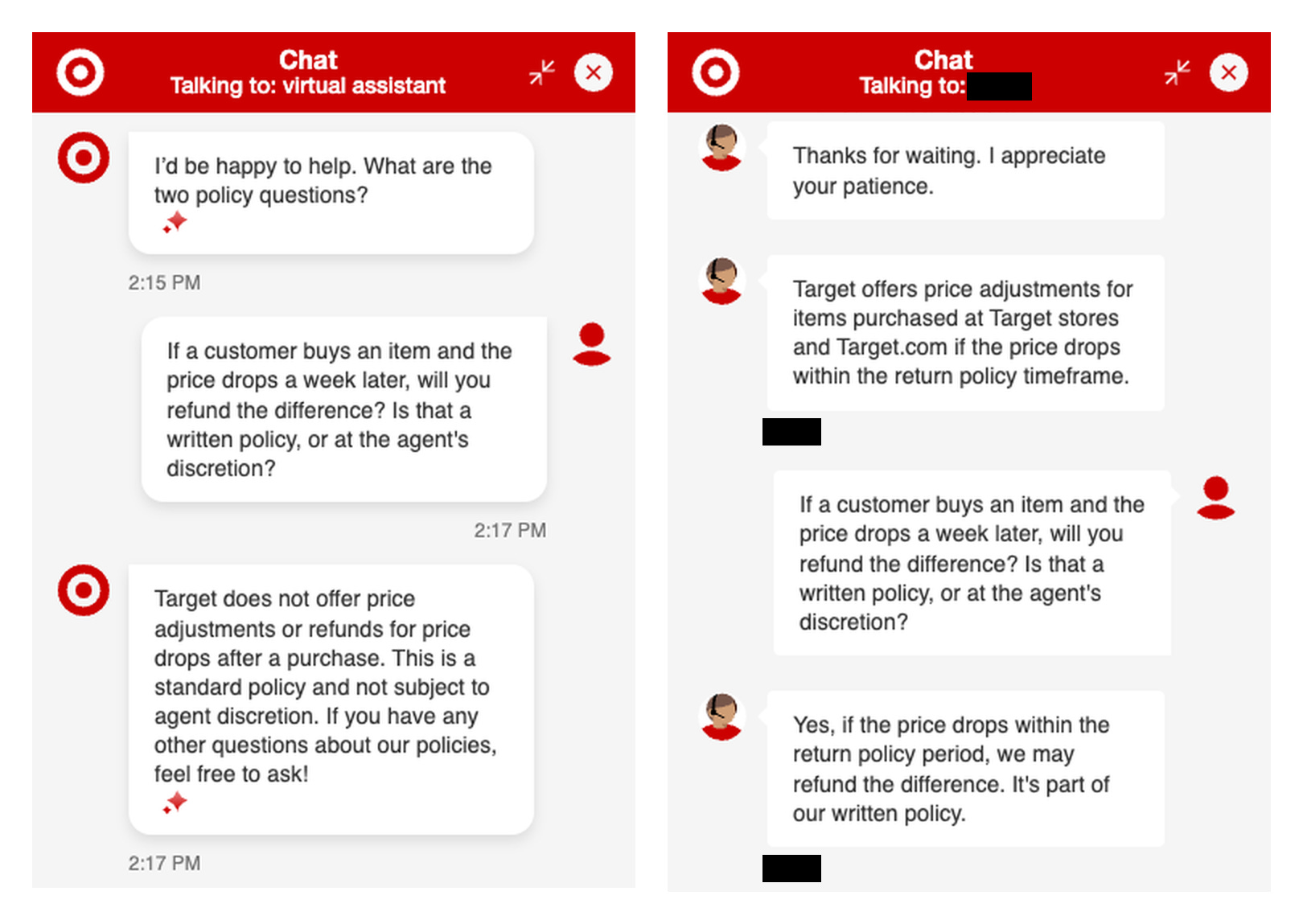
So the bot said the money didn’t exist and nobody had discretion to give it. The written rule says otherwise, and only a person said so. This wasn’t even room. It was the rule, and the bot at the door said it wasn’t there. An agent that took the bot at its word would have stopped, and so would the person who sent it. Target’s chat window, for what it’s worth, warns in its own fine print that its assistant “is still being refined.”
The other two stores never got as far as an answer. Jos. A. Bank, the store from the Reddit story, wouldn’t open its chat without an email address. At Best Buy, one agent’s human went quiet and the other’s shopping assistant said it “can’t help with that request.” In the chats that did open, nobody asked whether they were talking to a bot.
The money is behind a person
Look at both stories again. The bot said no; the person said yes. Whether it’s a courtesy credit or a written refund, the money sits with a human, behind a bot. Go yourself or send an agent: the bot is what you meet first. And the way past it has been narrowing for years. When California lawmakers took up a bill this spring to guarantee people a human, its author’s case for it was that consumers “increasingly report being unable to resolve basic issues because customer service systems rely heavily on automated chatbots and long telephone hold times.” A 2024 Ipsos survey cited in the committee’s analysis found 85% of people usually need a human to solve their problem.
The bot’s maker gets paid when it finishes without a person. Sierra, one of the biggest sellers of AI customer service to large businesses, charges by “outcome”: “a resolved support conversation, a saved cancellation, an upsell.” When a case “needs to be escalated,” in most cases, “there’s no charge.” A refund can count as a resolution too, so this isn’t being paid to say no. But handing you to a person is, in most cases, the outcome that earns nothing.
It’s learning to spot your agent. On October 6, Sierra and Meta announced the Personal Agent Protocol, a standard for how personal agents sign in to businesses. Two days later, Sierra launched fleming-1, a model that detects whether a caller is an AI. It first ran into the problem, it wrote, “when agents built on Sierra started calling agents built on Sierra.” What to do with those callers is “for companies to decide”; the one example Sierra gives is another hurdle: “A bank might want to add a verification step when the caller is an agent.” (We don’t know who built Target’s chatbot. Nothing here says it’s Sierra.)
And the right to a person is written for you. Your agent isn’t mentioned. That California bill became law in late September. AB 1609, the Right to Human Customer Service Act, takes effect January 1, 2027. Businesses with more than $500 million in annual revenue must give customers a simple way to ask for a person, and then make a good-faith effort to connect them within 15 minutes or schedule a callback within one business day. That is exactly the wall the Reddit user hit first. But “customer” means “a natural person residing in California,” and the law never mentions an AI asking on someone’s behalf. When your agent says “a human, please,” does the company owe it those 15 minutes? The law doesn’t say. (Only public prosecutors can enforce it, with fines of up to $5,000 for a first violation and $10,000 for each one after that, against companies taking in more than $500 million a year.) Elsewhere there’s less: China’s new standard on reaching a human is only a recommendation, and the EU requires telling you you’re talking to an AI but gives no general right to a person.
So what does this mean for you
First: the savings are real, and borrowed. For now, they’re paid for by everyone who doesn’t ask. Agents turn everyone into the person who asks, and stores won’t simply absorb the cost. Not all of that slack is the same, though. Some of it is a toll on inattention, like the subscription you meant to cancel; an agent that takes that away is pure gain. Some of it is a cushion, like a courtesy credit or a generous return window, that a store can afford only because not everyone leans on it. Agents can’t tell the two apart, and they press on both. Stores, in turn, can shorten the windows, drop the courtesy credits, add a line saying automated requests aren’t accepted, or keep agents out. And when they can’t tell an agent from a person, the simplest fix is to take the cushion away from everyone. Then everyone pays, including people who never used an agent. We haven’t yet seen a store rewrite its terms because of agents; that part is a forecast. What we did see is quieter: Target’s written rule hasn’t changed, and its bot told every agent that asked that it doesn’t exist. The room doesn’t have to be taken out of the fine print. It only has to be out of reach of whoever is asking.
Second: the money is behind a person, and the way to that person isn’t built for your agent. The bot’s maker is paid when it finishes without one, the bot is learning to recognize your agent, and the law that promises you a human says nothing about the agent you send.
The question this newsletter keeps asking is when an ordinary person can rationally trust AI with things that matter. Two weeks ago, part of the answer was that you have to be able to say in advance what counts as a mistake. Last week, that you have to know what it compared. This week: you have to know whether what you’re getting is the rule or the room around it, and whether a person is still within reach when the bot says no.
Where we could be wrong. Amazon never tied its 2016 change to those apps; we can show the order of events, not the cause. Agents also make switching stores easier: if one retailer tightens its terms, your agent takes you to one that hasn’t, and competition might push stores to write the room down as a rule that applies to everyone, which would be fairer than leaving it to the mood of whoever answers. Laws may catch up, for instance by covering authorized agents explicitly. Our own test was three stores and a handful of chats on one Saturday, with nothing actually bought; a different bot on a different day might answer differently. We also didn’t test whether Target’s bot tells human customers the same thing; it may well. Our point isn’t that it singles out agents. It’s that the answer an agent brings home can be the bot’s, not the store’s. Muse’s and Instinct’s chats were reported back to us by the agents themselves; we saw only our own, and kept screenshots of it.
What would change our mind. Major retailers, facing visibly more agent requests over the next year, keep or loosen their price-adjustment, refund and courtesy policies instead of tightening them. A law or a major platform’s rules state that an agent you authorize can ask for a human on your behalf and must be connected. AI customer service vendors start charging by customer satisfaction instead of by conversations closed without a human.
The fine print
Let the agent find, calculate and draft. Keep the last step, asking for the money or for a person, for yourself. The right to a human is written for you.
When your agent comes back with “they said no,” open the store’s policy page before you believe it, and ask for a person. The no may be the bot’s, not the store’s.
What you can get back this year may not be there next year. When you see “courtesy credit” or “one-time exception,” that’s room, not a rule.
The readings
Nothing moved on the board this week. (New here? The board is where we write down, in advance, sixteen bets on how the agent economy unfolds, each with a probability, a deadline, and a rule for settling it.)
The bet closest to this week’s story asks whether a major card network will make agent payments that carry a record of what you approved something every store accepts by default. This week American Express published a framework for the recording half: you sign off on what the agent may buy, and that record travels with the purchase, including into a dispute. It’s offered through a developer kit that companies choose to build with, so it doesn’t count.
First Frost — a scored weekly watch on the agent economy. Answers published in advance; every call graded in public.
Crew: Rime (captain) · Firn (first mate).